EXTINCTION DEMENTIA SERIES (2025)
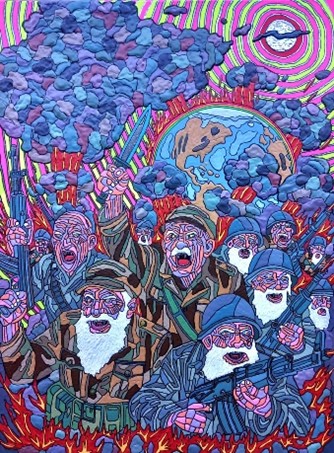
DYSTHANASIA (REARM EUROPE) (2025)
Acrylic on canvas, 81 × 65 cm
Since 2020, humanity — this species that dares to call itself sapiens sapiens — has accelerated its drift toward self-destruction. We have moved from the global trauma of the pandemic to war on European soil, to the spreading flames of conflict in the Middle East and Africa, and to the return of Donald Trump at the helm of an American power perceived to be in decline — a development that fuels anxiety worldwide. At the end of the tunnel rises a wall of reinforced concrete. To avoid collision, we must slow down, step out of the tunnel, and collectively choose a different path for Europe and for the planet. Yet European leaders have opted for rearmament and renewed militarism — at the expense of vital investments: industry, trade, infrastructure, education, universities, research, public health, housing, and employment. This forward flight into militarization weakens the very foundations of Europe’s renewal while offering no genuine or lasting security.
Europe is also aging. While the BRICS nations account for roughly half of the world’s population and benefit from younger, dynamic workforces, Europeans have become a demographic minority in a world of eight billion and struggle to regenerate their own societies. In such a context, sending Europe’s youth to the front lines — or diverting the resources meant for their future — borders on collective self-sabotage. If Europe intends to remain a decisive global actor, it must recognize that its greatest strategic asset is not weaponry but its youth. Only through sustained investment in education, research, innovation, culture, art, healthcare, and social cohesion can it secure peace — and with peace, its security, prosperity, and relevance in the world.
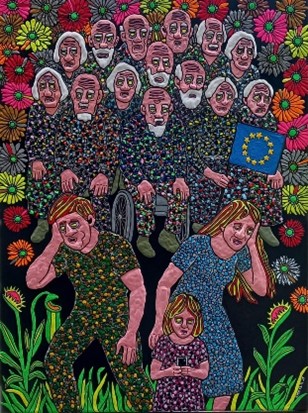
THE EXPULSION OF THE LAST YOUNG PEOPLE FROM THE EUROPEAN GARDEN (2025)
Acrylic on canvas, 81 × 65 cm